

Code Development
- voxelDVC - global Digital Volume Correlation (click)
- sigmaSPH - Smoothed Particle Hydrodynamics for fluids and solids (click)
voxelDVC
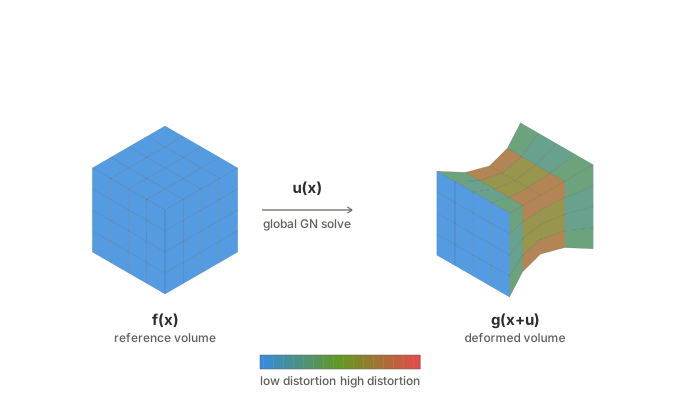
voxelDVC is a GPU-accelerated program for Digital Volume Correlation (DVC). Given a reference volume and a deformed volume of the same specimen, recorded by X-ray computed tomography before and after loading, it computes the displacement field on a structured finite-element mesh of eight-node hexahedra. The solver is matrix-free, so its memory use grows only with the number of voxels, and high-resolution volumes can be processed on a single GPU.
The source code is available under the MIT licence at github.com/ggalu/voxelDVC.
associated publication:
 |
G.C. Ganzenmüller, voxelDVC: a matrix-free, GPU-native global Digital Volume Correlation solver for high-resolution computed tomography, SoftwareX, accepted for publication, 2026. |
sigmaSPH
 |
|---|
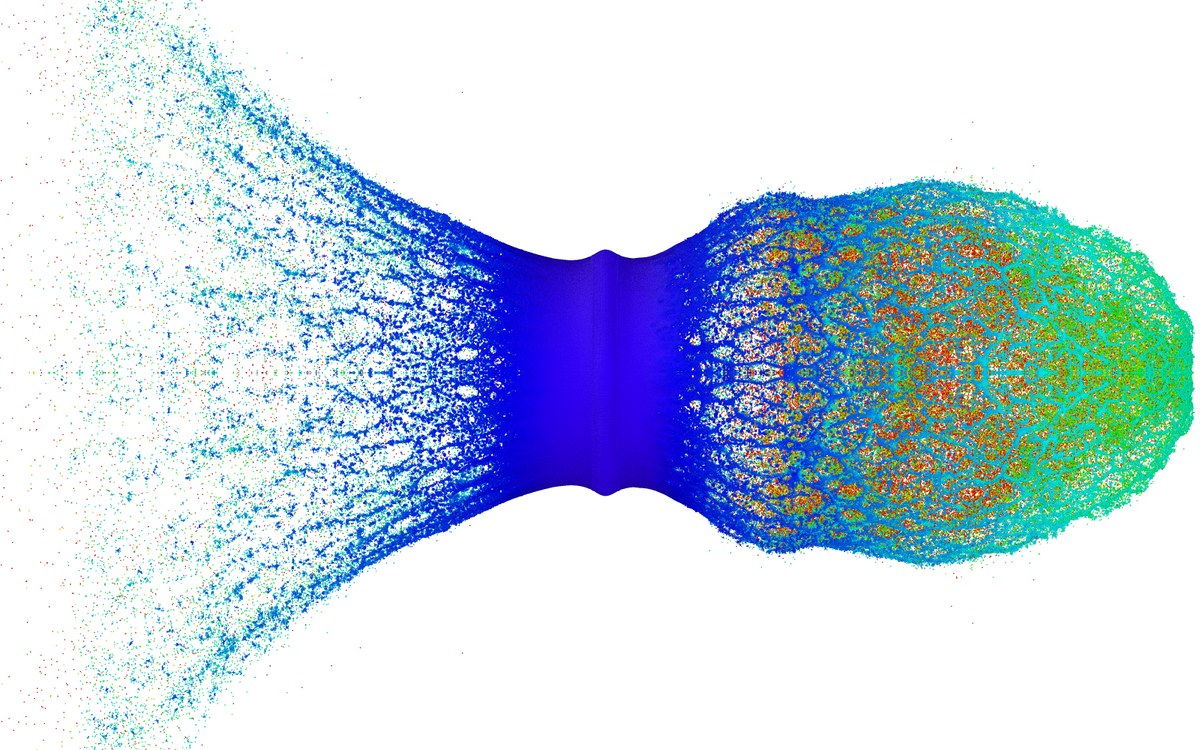
| Debris cloud of an aluminium sphere (Al 2017-T4) that has perforated a 2 mm aluminium disc at 6.7 km/s, computed with sigmaSPH. |
sigmaSPH is a GPU-accelerated Smoothed Particle Hydrodynamics (SPH) code written in Taichi. It simulates weakly compressible fluids and elastic-plastic solids at large deformation, in 3D, 2D plane strain and 2D axisymmetry. For solids, it provides equations of state for shock loading, J2 and Johnson-Cook plasticity, several damage models, and particle shifting in an arbitrary Lagrangian-Eulerian (ALE) formulation, which makes it suited to impact and fracture problems.
The source code is available under the MIT licence at github.com/ggalu/sigmaSPH. Every release is archived on Zenodo, https://doi.org/10.5281/zenodo.23084820.
associated publication:
- G.C. Ganzenmüller, Hourglass control for solid SPH-ALE: Stability and convergence under tensile loading, submitted to Computer Methods in Applied Mechanics and Engineering, 2026. Preprint: SSRN.